

RUSSIAN BLACK TERRIER STANDARD (FCI NUMBER 327)
10.01.2011/EN
FCI-Standard N° 327
RUSSIAN BLACK TERRIER
TRANSLATION: Dr. E. Yerusalimsky, O. Kornienko. Revised by Renée Sporre-Willes/ Original version: (EN).
ORIGIN / PATRONAGE: Russia.
DATE OF PUBLICATION OF THE OFFICIAL VALID STANDARD: 13.10.2010.
UTILIZATION: Working dog, guarding dog, sporting- and companion dog.
FCI-CLASSIFICATION: Group 2 Pinscher and Schnauzer – Molossoid breeds – Swiss Mountain Dogs and Cattle Dogs.
Section 1.4 Pinscher and Schnauzer.
Working trial optional.
BRIEF HISTORICAL SUMMARY: TheRussianBlack Terrier was created in Russia during the late 1940s and the early 1950s by selective interbreeding of breeds like the Rottweiler, Giant Schnauzer, Airedale Terrier and Newfoundland Dog. The Giant Schnauzer is considered to be the main ancestor of the breed. The initial breeding was supervised by the military cynological school outside Moscow and the dogs were based in their kennels named “Red Star”. The aim of the creators of the breed was the development of a large, brave, strong and manageable working dog with pronounced guarding instinct; a dog which could be useful for many services and adapts well to various climate conditions. The breed was recognized by the FCI in 1984.
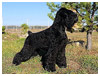
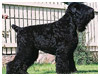
GENERAL APPEARANCE: The Russian Black Terrier is a large dog with a slightly long body and very athletic built of a robust type and hardy constitution. The breed has qualities like massive bone and powerful muscles. It is symmetrical with a large head and compact body and a voluminous and deep chest. Differences between the sexes to be clearly defined.
IMPORTANT PROPORTIONS: The length of the body is slightly longer than the height at the withers, could be more pronounced in females.
Depth of chest should not be less than half the height at the withers. Length of head should not be less than 40 % of the dog’s height at the withers. The muzzle is slightly shorter than the skull.
BEHAVIOUR AND TEMPERAMENT: A dignified and confident dog; well controlled in all situations. When circumstances require, he immediately assumes an active-defensive posture, however, quickly calms down at the disappearance of threat. This handsome breed is amiable and has great endurance; it is undemanding, smart and friendly. It adapts well to training and various climate conditions and is hard working and reliable.
HEAD
CRANIAL REGION: Head should be in proportion to body, although large, massive and long.
Skull: Moderately broad with flat forehead. Topline of skull is parallel with topline of muzzle. The superciliary arches and occipital bone are moderately pronounced.
Stop: Noticeable but not sharp.
FACIAL REGION:
Nose: Large and black.
Muzzle: Strong, broad and slightly shorter than skull. Muzzle is wide at base and narrowing slightly to the tip of the nose. Moustache and beard accentuated volume and give the muzzle a rectangular, blunt appearance.
Lips: Thick, well pigmented and tight. Lip rims dark.
Jaws/Teeth: Large, white teeth that are tightly adjacent to each other, the lower incisors positioned in a line. Full dentition (42 teeth). Scissors bite.
Cheeks: Dry cheek bones with rounded but not pronounced cheeks.
Eyes: Medium size, oval shaped, set straight and wide apart, dark colour. Eye rims dry, tight and black.
Ears: Hanging. Set high and symmetrical, medium sized, triangular shaped. Front edge close to cheek. Ear leather is dense, without folds.
NECK: Strong, dry and muscular. The length of the neck is approximately equal to the length of head and set at an angle of 45-50 degree to the horizon. The nape is strong and well developed.
BODY: Solid, deep and voluminous, well balanced.
Topline: Slightly sloping from the withers to the root of the tail.
Withers: High and well developed, more pronounced in males than in females.
Back: Strong, straight and muscular. The length of the actual back is equal to ½ the length measured from the withers to the base of the tail.
Loin: Wide, short, muscular and slightly arched. The length is equal to ½ the length of the actual back.
Croup: Broad, muscular, slightly sloping and of moderate length.
Chest: Deep, long and broad with slightly sprung ribs. The shape of the thorax (in cross section) is oval. The breast bone is long and the fore chest slightly extends the shoulder joint and is well muscled.
Underline and belly: On the same line as the elbow joint or slightly below. Belly moderately tucked up. Flanks only slightly developed.
TAIL: Thick at root and set high. In movement the tail is carried jauntily but the root of the tail does not incline over the back (squirrel tail).
Tail traditionally docked in country of origin. An undocked tails length or shape has no influence on the evaluation of the dog. Preferable shape of the undocked tail is sabre or sickle.
LIMBS
FOREQUARTERS:
General appearance: Forelegs when viewed from the front are straight and parallel. The distance from the elbow ulna to the ground is equal to 50-52% of the dogs’ height at the withers.
Shoulder: Long, broad and well-laid back. The angle between shoulder blade and upper arm is approximately 100 degrees.
Upper arm: Muscular and no shorter than the shoulder-blades.
Elbow: Close to body.
Forearm: Straight, thick, round bone. Vertical when viewed from the front and side.
Metacarpus (Pastern): Short, massive and slightly sloping when viewed from the side.
Forefeet: Large, compact and round in shape. Nails and pads are black.
HINDQUARTERS:
General appearance: When viewed from behind straight and parallel, set wider than the forelegs. When viewed from the side placed slightly behind the dog.
Thigh: Moderately long, slightly inclined, wide with well developed, voluminous muscles.
Stifle: Well bent.
Lower thigh: No shorter than thighs.
Metatarsus (Rear Pastern): Strong, low and vertically positioned. No dewclaws.
Hind feet: Slightly smaller than front feet and tending oval shape. Nails and pads are black.
GAIT / MOVEMENT: Free and well balanced with smoothly bent joints. The typical gait is an energetic trot with long strides which comes from the powerful rear drive and significant reach in the forequarters. Topline to remain firm.
SKIN: Tight, well fitted without folds or loose skin, still elastic. Evenly pigmented.
COAT:
Hair: Rough and thick double coat. Composed of a coarse, thick, slightly waved outercoat and a soft, short and dense undercoat. The outer coat covers the whole body. The natural and untrimmed coat length is between 5 – 15 cms. The head furnishing is very well developed and forms abundant eyebrows, moustaches and beard.
Legs are covered in long, dens furnishing coat. Grooming in the correct form is required.
The clipped coat should emphasise the character of a strong and assured dog and by no means be excessively decorative. The coat is left longest on legs and around the muzzle. The clipping should accentuate the massive head with flat forehead, well lying ears, strong neck and well constructed, strong body.
Colour: Black, black with insignificant intermingling gray hair is permissible. (Grey intermingling hair not to cover more than a 1/3 of the whole body).
SIZE AND WEIGHT:
Desired height at the withers:
Males: 72 - 76 cms. but no less than 70 cms. and not more than
78 cms.
Females: 68 - 72 cms. but no less than 66 cms. and not more than 74 cms.
Slightly taller specimens are tolerated providing they are proportionate and of excellent breed type.
Weight:
Males: 50 – 60 kgs. Females: 45 – 50 kgs.
FAULTS: Any departure from the foregoing points should be considered a fault and the seriousness with which the fault should be regarded should be in exact proportion to its degree and its effect upon the health and welfare of the dog and on its ability to perform its traditional work.
- Skull rounded.
- Partial lack of pigmentation on lips.
- Incisors not in line in lower jaw. Small incisors.
- Eyes round; slightly light coloured; oblique or narrow set.
- Neck too short and not muscular enough.
- Withers not pronounced.
- Swayback, or narrow back.
- Loin too long; narrow; not muscular enough.
- Shoulders too straight.
- Forearms too short.
- Elbows turned in or turned out.
- Feet turning in or turning out.
- Hocks turned in, out or sickle.
- Pacing interspersed when trotting.
- Guardcoat soft or smooth.
- Rusty shading in guard coat.
- No undercoat.
SEVERE FAULTS:
- Deviation from sex type.
- Timid or overexcited behaviour.
- Head short or light.
- Visible third eyelid, light coloured eyes.
- Croup horizontal or too steep.
- Chest shallow or short.
- Squirrel tail.
- Bowed forearms.
- Movement restricted; sluggish or heavy.
- Guardcoat silky.
DISQUALIFYING FAULTS:
- Aggressive or overly shy.
- Any dog clearly showing physical or behavioural abnormalities shall be disqualified.
- Deviation towards the ancestry breeds.
- Nose other than black.
- Wall eye or different coloured eyes.
- Deviation from scissor bite or missing teeth.
- Guardcoat smooth and lack of head, chest and leg furnishing.
- Any other colour than the ones described.
- White spots or markings.
- Clearly defined patches of grey hair.
N.B.: Male animals should have two apparently normal testicles fully descended into the scrotum.